


To address high background, limitation of restriction sites, and other issues of traditional cloning, cloning by seamless cloning has become well known, which uses Homology sequence-containing primers to ligate vectors and inserts. The technique should have addressed the aforesaid issues to ensure successful cloning, but ligation is still often inefficient during experiments. So, what went wrong? Let’s get started from primers.
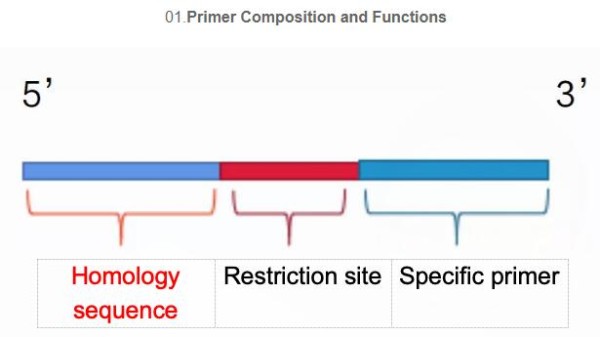
Restriction site: Retain or not depending on subsequent experimental needs.
Specific primer: Amplify the inserts by PCR to introduce Homology sequences.
Homology sequence: With the specific primer sequence of the primers for recombination, the insert is amplified for ligation with Homology sequences and then ligated to the vector under the catalysis of recombinase.
The Homology sequences play a crucial role in ligating the insert to the vector.
Take people’s time. Does the Homology sequence meet the design requirements?
02.Homology sequence Design Specification
Length: 15 – 20 bp
Position: end of the vector sequence
GC Content: 40% – 60%
Why are there so many requirements? Can it be designed freely?
That often comes with a cost: inefficient ligation.
• A too-short (< 13 bp) Homology sequence may cause unstable ligation due to no ligation activity.
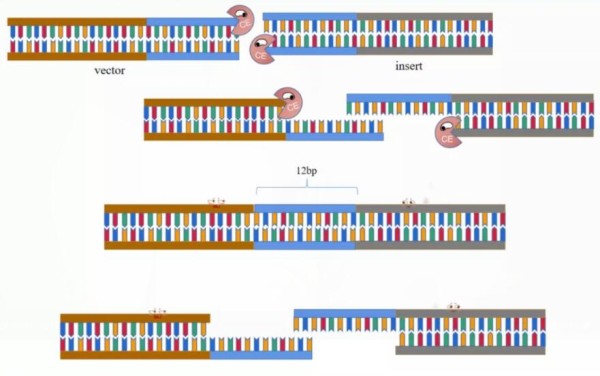
• A too-long (> 25 bp) Homology sequence may cause ligation failure due to insufficient enzyme digestion.
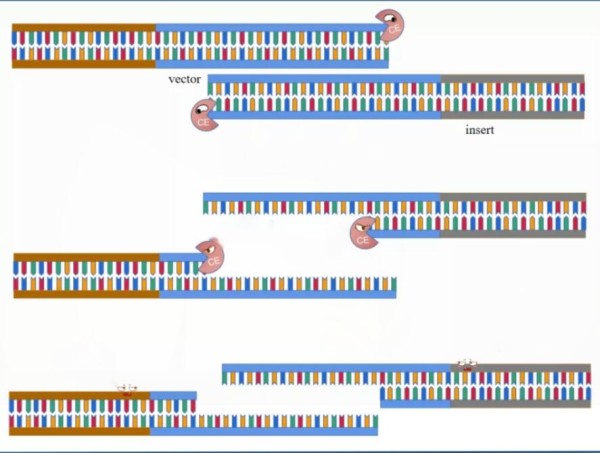
• A Homology sequence not positioned at the end sequence of the vector may cause ligation failure because of inability of the enzyme to digest the target sequence for ligation.
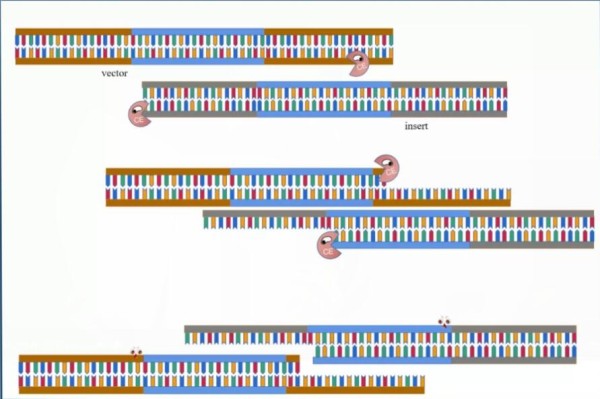
• A Homology sequence designed as required ensures perfect ligation.
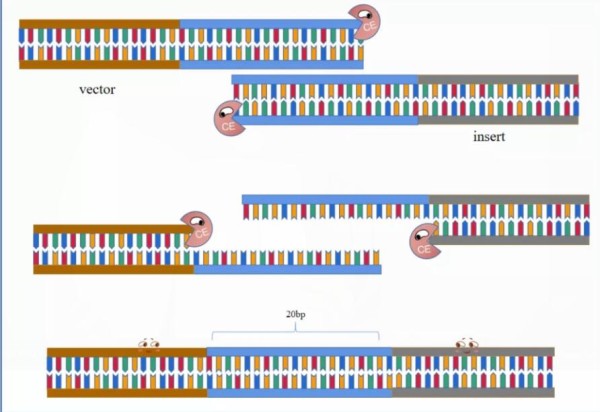
Too high or too low GC content may not entail a successful reaction. The GC content relates to the sequence near the vector’s restriction site. If the GC content of the sequence of the restriction site is too high, inverse PCR can be used to amplify vectors carrying appropriate end sequences.
03.Vazyme Fast Cloning Kit
|
Product Name |
Cat. No |
Features |
ClonExpress Ultra One Step Cloning Kit V2
|
C116 |
Homology sequence: 15 – 35 bp Suitable for 1 – 5 fragments cloning Recombination only takes 5 – 30 minutes The postive rate > 95 % |
ClonExpress Ultra One Step Cloning Kit
|
C115 |
Fast: Recombination only takes 5 – 15 minutes Compatible: Suitable for 1 – 5 fragments cloning Effient: Efficiently clone 50 bp – 10 kb fragments, the positive rate is >95 % |
ClonExpress MultiS One Step Cloning Kit
|
C113 |
Suitable for multiple fragments cloning
|
ClonExpress II One Step Cloning Kit
|
C112 |
Suitable for single fragments cloning
|
Learn more information or place order online, please visit: www.vazyme.com
Media Contact
Company Name: Vazyme
Email: Send Email
Country: China
Website: https://www.vazymebiotech.com/