


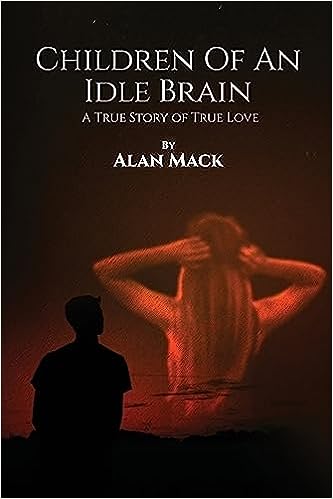
Many don’t believe that what we think of as romantic love really exists; that it is merely an imbalance, temporary or lasting, more or less benign or dangerous, in the complicated chemistry of the human brain. That romantic love is akin to, say, a virus, that can be identified, modified and perhaps someday “cured.”
Using the tools available to them to study the human brain, scientists are busy today trying to identify and quantify that ineffable “thing” that was commonly known simply as love throughout most of human history. Scientists look at things differently. It was scientists who figured out that the earth goes around the sun and not the sun around the earth; and since then, they are responsible for most of the world we live in. Thus, the study of love, once nearly the exclusive domain of artists, poets and novelists has been quietly ceded to those whose job is to quantify rather than characterize.
That is why Children Of An Idle Brain is told exactly as it happened, a true story, and not as a novel or even one “based on real events.” In that way it meets the demand of science for accuracy. Thus, it is a kind of scientific study of love as it actually affected real human lives in a particular place and time, with real results that can be assessed by the reader.
Jane Austen portrayed love among the gentry of Regency England, a limited class in a limited time. Similarly, Tolstoy, in Anna Karenina, explored love among the aristocrats of Tsarist Russia in an age of reform. Scott Fitzgerald, in The Great Gatsby, the meeting of old money and new money during the turbulent Jazz Age.
Like those novels, Children Of An Idle Brain describes love as it occurred in a particular social class, the American upper middle class, but during a more extended period, the second half of the Twentieth Century, an age of seeming liberation. During those fifty years the principals in the story grew up, lived their adult lives and began to age. They are all retired now.
Human beings are complicated, often contradictory creatures. Why do they do or think certain things and then change their minds, and why do they do it at the moment they do it? Why do they dream what they dream? How does the brain in love differ from the resting brain? These are the puzzles Children Of An Idle Brain describes in detail, in all their density, circumstance and confusion.
If you want to see what made real lovers tick, in real time, read Children Of An Idle Brain. Visit Amazon right away to experience the thrall of this outstanding book.
About the Author
Alan Mack was a typical suburbanite who experienced modest business success. You could meet him on a tennis court, in a place of business or at a PTA meeting. Yet he was also a fool for love, with dire consequences. Despite that and some of the inevitable embarrassing moments that produced, he believes that such a “case study” will be of interest to the general reader, who may begin to look at those around him a little differently. Alan’s book is an unfiltered look into the emotional world of the American middle class.“
Book Name: Children Of An Idle Brain
Author Name: Alan Mack
ISBN Number: 978-1088154748
Ebook Version: Click Here
Paperback Version: Click Here
Hardcover Version: Click Here
Media Contact
Company Name: Amazon Publishing Agency
Email: Send Email
Phone: 877 384 2440
Country: United States
Website: www.amzpublishingagency.com