


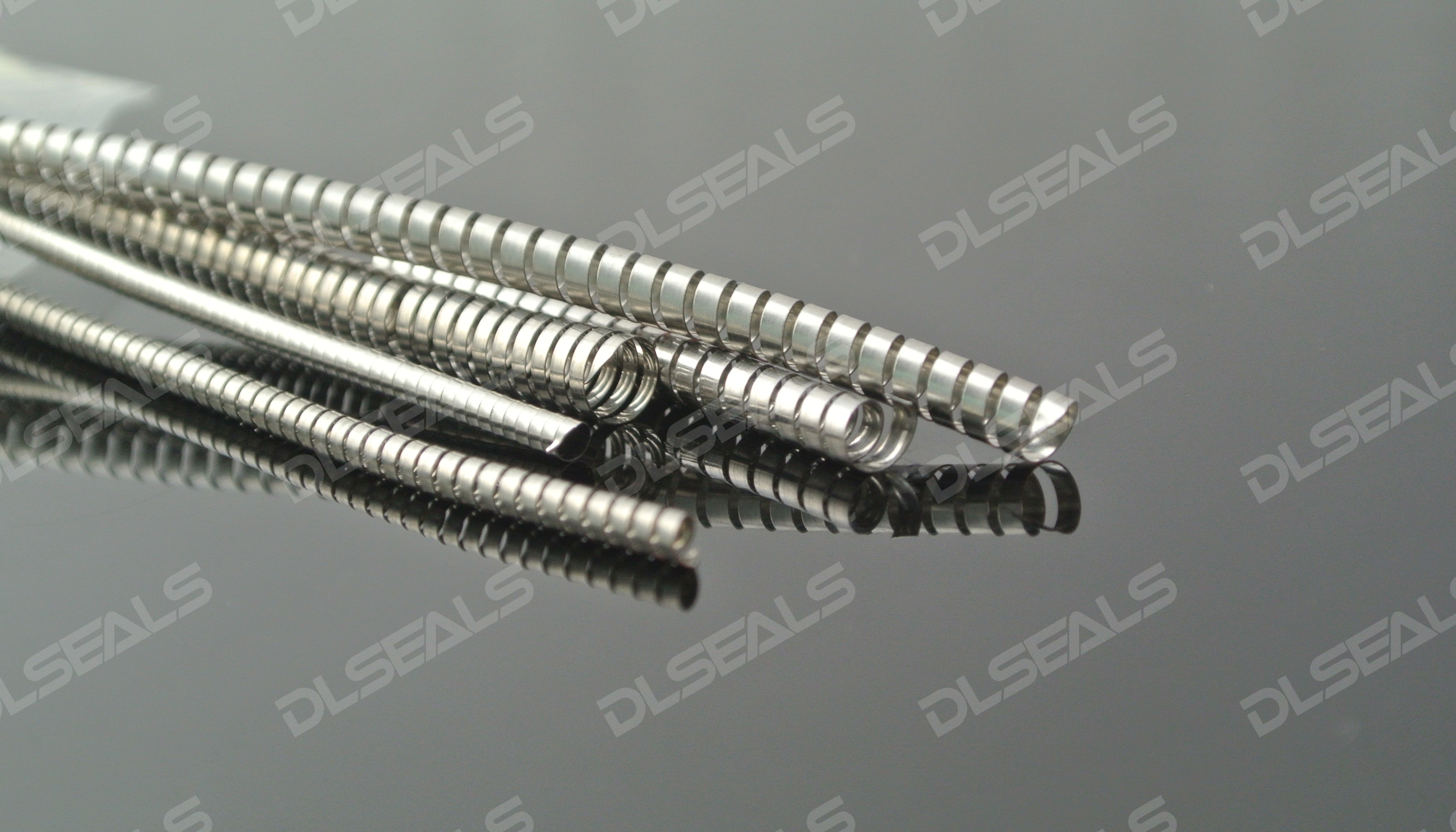
In the industrial field, sealing elements are critical components for preventing fluid leakage (such as oil, water, chemicals, or gas). Among the variety of seals, there is a category of high-performance sealing rings whose core contains a “power heart” – a spring. It ensures that the seal maintains long-term, stable sealing performance even under harsh operating conditions. This article delves into the main types of springs used in sealing rings and their unique roles.
I. Why is a Spring Needed? – The Core Function of the Spring
In dynamic sealing applications (e.g., rotating shafts, reciprocating piston rods), the sealing lip can gradually lose tight contact with the mating surface due to wear, material expansion/contraction from temperature changes, and shaft misalignment, leading to leakage. The core function of the built-in spring is to provide a continuous and stable radial compensating force to:
- Compensate for Wear: Automatically take up the clearance generated by long-term wear.
- Accommodate Tolerances: Compensate for dimensional and geometric tolerances of the shaft or housing.
- Handle Thermal Expansion/Contraction: Maintain sufficient sealing contact pressure during significant temperature fluctuations.
- Ensure Constant Sealing: Guarantee that the sealing force does not significantly diminish throughout the service life.
Seals with such springs are typically called spring-energized seals, the most common example being the Spring-Energized Seal.
II. Main Spring Types and Their Characteristics & Applications
The type of spring directly determines the performance and application of the sealing ring. Below are several mainstream spring types:
1. V-Spring (V-Spring)
- Structure: Made from precision-stamped stainless steel strip, forming a continuous V-shaped structure; the cross-section resembles a series of “V”s.
- Function & Advantages:
- Uniform Radial Force: Provides a very smooth, even radial load, leading to uniform lip wear and stable sealing.
- Low Friction: Relatively low friction during movement due to small contact area with the seal inner wall.
- Kink Resistance: The continuous ribbon structure makes it resistant to twisting or kinking during installation, especially suitable for large diameters.
- Typical Applications: The most versatile and common type, suitable for most rotary, reciprocating, and static applications; the first choice for many standard spring-energized seals.
2. Helical Coil Spring (Helical Coil Spring)
- Structure: Made from round or rectangular cross-section wire wound into a continuous helical coil.
- Function & Advantages:
- High Spring Force: Provides higher unit area spring force than V-springs, resulting in stronger sealing pressure.
- Excellent Compression Resistance: Especially coils made from rectangular wire (Canted Coil Spring) excel at resisting axial compression and side loads, and are less prone to collapsing under high pressure.
- Low-Temperature Resistance: Lower rate of spring force decay in very low temperatures compared to V-springs.
- Typical Applications:
- High-Pressure Conditions: Often used for static and dynamic sealing under extreme high pressure.
- Low-Temperature Conditions: Such as cryogenic media like LNG, liquid nitrogen, liquid oxygen.
- Large Clearance Applications: Better at compensating for larger radial clearances and eccentricity.
3. U-Spring (U-Spring)
- Structure: Similar in structure to the V-spring, but the cross-section is “U”-shaped.
- Function & Advantages:
- Medium Spring Force: Its spring force characteristics are between those of V-springs and helical coil springs.
- Cost-Effective: Generally lower manufacturing cost.
- Typical Applications: Found in some cost-sensitive, low to medium pressure applications where conditions are not extreme; less common than V and helical springs.
4. Wave Spring (Wave Spring)
- Structure: A flat metal ring with multiple continuous peaks and valleys.
- Function & Advantages:
- Compact Space: Requires minimal axial installation space, ideal for thin-wall, compact designs.
- Controlled Force: Capable of providing precisely designed preload force.
- Typical Applications: Primarily used for static sealing, acting as a preload compensation element for O-rings or other elastomeric gaskets, not for lip compensation in dynamic seals.
III. How to Choose the Right Spring Type?
Selecting the spring type requires comprehensive consideration of the following factors:
- Operating Pressure: Helical spring is preferred for high pressure; V-spring is a good choice for low/medium pressure.
- Motion Type: V-springs providing uniform force are prioritized for rotary sealing; both can be used for reciprocating motion.
- Temperature Range: Helical springs (especially rectangular wire) are more reliable in very low temperatures.
- Media Compatibility: Spring material (usually 304 or 316 stainless steel) must be compatible with the medium; highly corrosive environments may require special materials like Hastelloy.
- Space Constraints: Wave springs can be considered for static sealing when axial space is limited.
- Cost Budget: V-springs offer high cost performance; helical springs offer excellent performance but at a relatively higher cost.
Conclusion
Though small, the spring is the soul of a spring-energized seal. From the V-spring providing uniform pressure to the helical spring granting ultra-high pressure resistance, each type is born to solve specific engineering challenges. Understanding their unique functions and applicable scenarios is a key step in selecting the most suitable and reliable sealing solution for equipment, thereby effectively enhancing reliability, efficiency, service life, and eliminating leakage risks.
Media Contact
Company Name: Guangdong DLSEALS Technology Co., Ltd.
Email: Send Email
Country: China
Website: https://www.dlseals.com/